This question gets typed into search bars quietly — usually after something felt off, or after someone mentioned it in passing and you realised you’d never actually thought about it properly. Nobody teaches this. And the beauty industry profits from the confusion either way.
Intimate wash vs soap is a comparison that genuinely matters — because the answer directly affects vaginal pH, the microbial balance that protects you from infections, and whether your daily hygiene routine is helping or quietly working against you.
Here’s the straight version: regular soap isn’t designed for intimate use, and using it routinely disrupts more than it cleans. A correctly formulated intimate wash works with your body’s natural environment rather than against it. But “feminine hygiene” marketing is also full of noise — knowing the difference between what’s real and what’s branding is what this article covers.
The Real pH Difference Between Intimate Wash and Soap
Most people treat this as a mild preference question — like choosing between two shampoos. It isn’t. The difference is chemical and has real, measurable consequences for vaginal health. Understanding the science behind intimate wash vs soap helps explain why one supports vaginal balance while the other can gradually disrupt it.
pH — where it starts
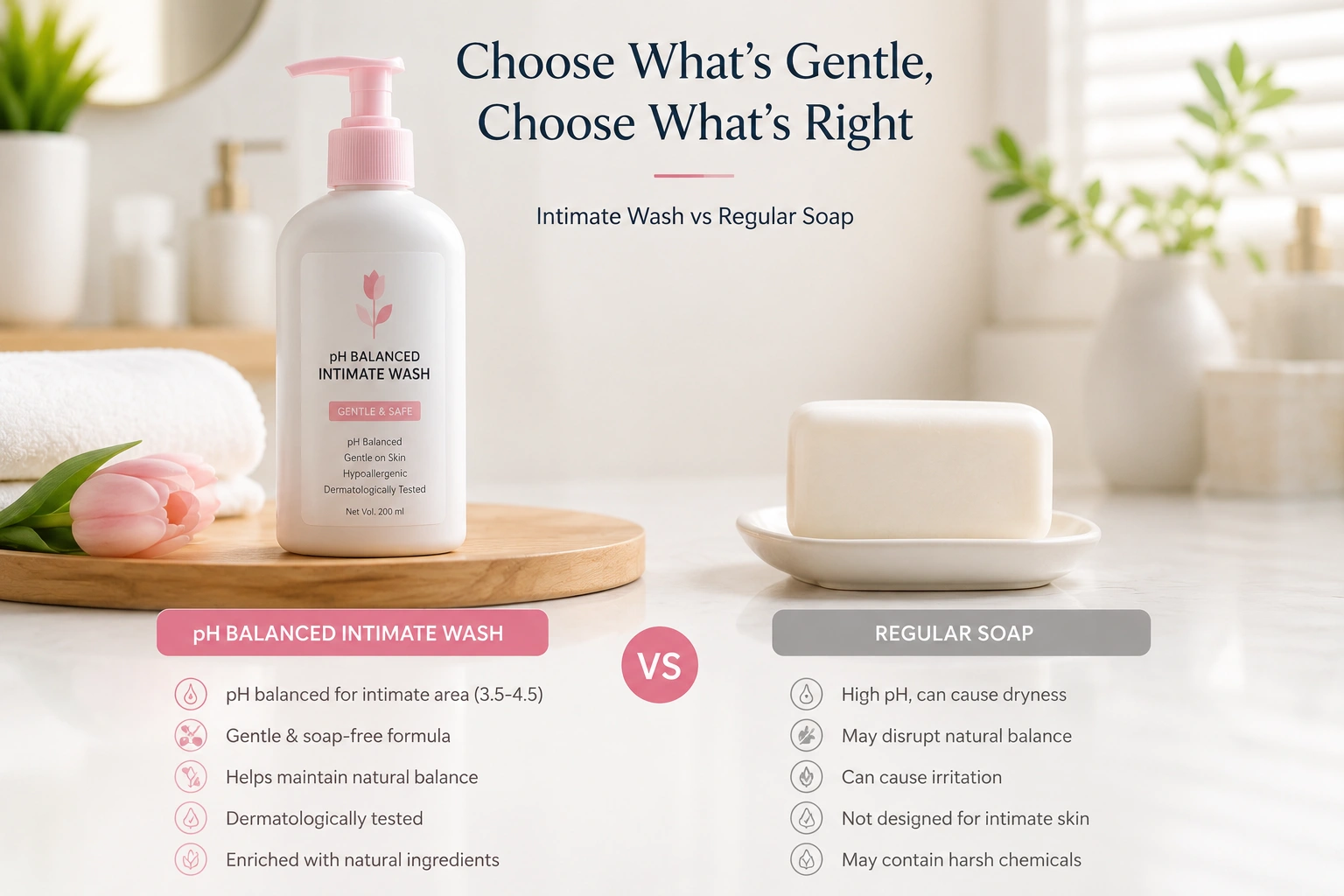
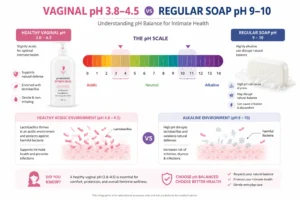
Standard soap is alkaline, sitting between pH 9–10. The healthy vaginal environment maintains a pH of 3.8–4.5 — mildly acidic, protected by Lactobacillus bacteria that produce lactic acid and actively suppress harmful microorganisms. Every time alkaline soap contacts the vulva and surrounding tissue, it temporarily raises the local pH. Done once in a while, the body self-corrects. Done daily, repeatedly, it shifts the environment in a direction where bacterial vaginosis and yeast infections find it easier to establish.
A correctly formulated intimate wash sits at pH 3.5–4.5 — matching the vaginal range, reinforcing rather than disrupting what’s already there. This pH difference is one of the biggest reasons the intimate wash vs soap debate matters for long-term vaginal health.
Surfactants and the skin barrier
Soap’s cleaning mechanism involves surfactants that break down oils. That works well on hands and body skin. Vulvar tissue is more sensitive, more permeable, and maintains a protective lipid barrier that reduces friction damage and infection risk. Repeated use of harsh surfactants strips that barrier — increasing dryness, micro-inflammation, and tissue vulnerability over time.
Fragrance — both categories can get this wrong
In the intimate wash vs soap conversation, fragrance is the variable both products can fail on equally. Scented soaps and scented intimate washes both carry synthetic fragrance compounds that are common triggers for vulvar contact dermatitis. Fragrance-free is the standard to hold both categories to — regardless of what the packaging looks like or what it costs.
The question isn’t which one cleans better. Both clean. The real question is what each does to the vaginal environment after — and the pH data answers that consistently.
Is Feminine Wash Actually Better Than Soap?
Short answer: yes — but only when it’s formulated correctly. The label doesn’t automatically make a product better. The chemistry does.
A properly formulated intimate wash for feminine hygiene is:
- pH-balanced at 3.5–4.5 — matching the vaginal environment
- Fragrance-free — synthetic and natural fragrance both cause irritation in sensitive intimate tissue
- Free from sulphates, parabens, and harsh preservatives
- Built on a gentle surfactant base that cleans without stripping the protective lipid layer
A poorly formulated intimate wash is still alkaline, still fragranced — just with “feminine” on the label and a different price point. The packaging changes. The chemistry doesn’t. This is the part most women never check.
Research published in the Journal of Obstetrics and Gynaecology Research found women using pH-balanced intimate wash reported significantly fewer vulvovaginal symptoms than those using standard soap — particularly among women with a history of recurrent bacterial vaginosis. The difference wasn’t about cleanliness. It was entirely about pH compatibility.
For women who don’t experience recurring issues, the practical minimum is unfragranced mild soap used only externally — never applied close to the vaginal opening. Location of application matters almost as much as product choice. The external vulva tolerates mild soap far better than tissue closer to the vaginal canal, which is significantly more pH-sensitive.
The consistent evidence across dermatology and gynaecology literature says the same thing: the intimate wash vs soap comparison favours intimate wash for daily use — not because soap is harmful occasionally, but because daily alkaline exposure to pH-sensitive tissue creates cumulative disruption. Quiet. Repeated. Adds up.
What’s the Best Wash for Female Private Parts — What Gynaecologists Actually Say

The best wash is the one that disrupts the vaginal environment the least while supporting what the body already does naturally. When gynaecologists answer this, the guidance is consistently less about product brands and more about non-negotiable formulation standards.
What to look for:
- pH 3.5–4.5 — without this, the product isn’t working with your body regardless of everything else it claims
- Fragrance-free — natural fragrance is not safer than synthetic for intimate tissue; both trigger reactions
- Lactic acid or lactobacillus-supporting ingredients — actively reinforces the bacterial environment rather than just leaving it alone
- No parabens, glycols, artificial dyes, or alcohol — all disrupt vaginal flora or damage the protective barrier in different ways
What to avoid regardless of marketing language:
- “Natural” doesn’t mean pH-safe — lemon, tea tree, and many plant extracts are alkaline or antimicrobial in ways that disrupt Lactobacillus as readily as synthetic chemicals do
- Vaginal deodorants and freshness sprays are the worst category available. They mask odour while actively worsening the environment underneath. Nothing about them solves anything.
- Anything that goes inside — douching, internal washes, anything beyond external use — removes the self-cleaning mechanism the vagina depends on entirely
For intimate hygiene for women practically: a pH-balanced, fragrance-free wash applied to the external vulva once daily is all that’s needed. According to the American College of Obstetricians and Gynaecologists, the vagina is self-cleaning — external gentle care is the full extent of what’s required from outside. (Source: ACOG — Vulvar Care Guidelines)
Wayveda’s formulations start exactly here — at the pH level, not at the marketing angle.
Conclusion
Intimate wash vs soap isn’t complicated once the pH chemistry is clear. Soap disrupts by default — repeatedly, cumulatively, without announcing itself. A correctly formulated intimate wash protects by staying within the range the vaginal environment already maintains.
The standard is simple: pH-balanced, fragrance-free, external use only. The vagina cleans itself. The goal of any product you use is to not undo that.
Good intimate care isn’t about doing more. It’s about doing the right things, consistently, without creating new problems in the process. Wayveda was built on exactly that principle — intimate wellness without judgment, and without the guesswork most products leave you with.
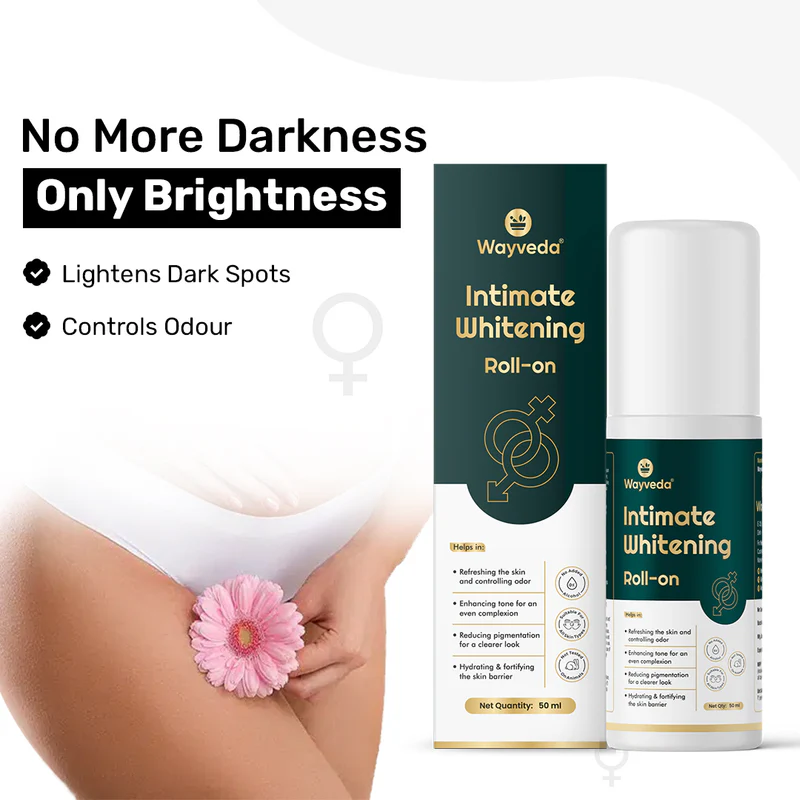
For intimate care that’s pH-conscious and genuinely free from harmful chemicals, Wayveda’s Intimate Whitening Roll-On — formulated personally by Dr. Neha Mehta, India’s Top Intimacy Expert — is built to work with your body, not against it. Explore on Wayveda →
Frequently Asked Questions About Intimate Wash and Soap
Q1: What feminine wash do gynaecologists recommend?
Gynaecologists typically don’t recommend specific brands — they recommend a formulation standard. pH between 3.5–4.5. Fragrance-free. No sulphates, parabens, or alcohol. External use only. Any product meeting those criteria gets a consistent recommendation across specialties. Products that add fragrance, colour, or “freshness” claims are almost uniformly what gynaecologists tell patients to avoid — regardless of the brand or price point.
Q2: Should you use soap on female private parts?
On the external vulva occasionally — a mild, unfragranced soap is tolerated by most women without major disruption. Daily use of standard alkaline soap, particularly near the vaginal opening, consistently raises pH and disrupts microbial balance over time. Inside the vagina — never, under any circumstances. Even gentle internal soap use removes Lactobacillus faster than it can repopulate, leaving the environment unprotected. Switch to pH-balanced wash for daily use.
Q3: How often should you wash your intimate area?
Once daily during bathing — externally only, with lukewarm water and optionally a pH-balanced wash. Over-cleaning is a real problem. Multiple washes daily, repeated wipe use, or douching removes protective bacteria faster than they repopulate. The vagina maintains itself through natural discharge. External cleansing supports that process — it doesn’t replace it, and doing too much actively undermines it.
Q4: Can an intimate wash cause infections?
A badly formulated one — yes. Intimate washes containing fragrance, high pH, alcohol, or parabens can disrupt vaginal flora and create conditions for bacterial vaginosis or yeast infections — the exact problems they claim to prevent. In the intimate wash vs soap comparison, a bad intimate wash can be worse than mild soap. Always check:
- pH clearly stated at 3.5–4.5
- Fragrance-free, not just “lightly scented”
- No alcohol in the ingredient list
Q5: Is vaginal odour a sign something is wrong?
A mild, natural odour is completely normal and varies across the menstrual cycle, after sex, and with hydration. A strong fish-like odour — particularly after sex — typically signals bacterial vaginosis and elevated vaginal pH. A sweet or yeasty smell often points to yeast overgrowth. Using scented products to mask odour makes the underlying environment worse, not better. A change in odour that persists beyond a few days is worth a clinical check — not a stronger-smelling product.
Q6: Does the type of underwear affect intimate hygiene?
More than most women connect to it. Synthetic fabrics trap heat and moisture — both of which favour bacterial and yeast overgrowth. Cotton underwear maintains better airflow, reduces local temperature, and absorbs excess moisture without creating the warm, damp environment microorganisms thrive in. Tight underwear compounds this further. Sleeping without underwear occasionally is one of the simplest, lowest-effort habits that consistently supports intimate health alongside a proper intimate wash vs soap routine.