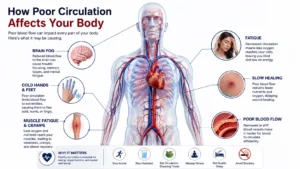
Poor circulation rarely announces itself dramatically. It shows up quietly — cold hands and feet that take too long to warm up, persistent fatigue that doesn’t resolve with sleep, concentration that drifts despite doing everything right. Wounds that heal slower than they used to. Muscle soreness that lingers longer than it should.
Natural ways to improve blood circulation are more accessible than most people realise — because circulation is highly responsive to consistent, specific inputs. Movement. Hydration. Specific foods and herbs. Temperature exposure. The body’s vascular system isn’t passive. It responds to what you do to it daily, and those responses compound meaningfully over weeks.
This covers what actually degrades circulation, what the research supports for improving it, and how blood flow connects directly to energy levels in a way most people haven’t been shown clearly enough.
What Poor Circulation Does to the Body — And the Natural Ways to Fix It
Before the solutions — the mechanism. Understanding why circulation deteriorates tells you exactly which interventions target the right level.
Blood circulation depends on three interconnected factors: vascular tone — how well vessels dilate and contract; blood viscosity — how easily blood flows through those vessels; and cardiac output — the force and rhythm of the pump driving it all. Poor blood circulation typically starts with vascular tone — vessels becoming less responsive, nitric oxide production declining, and endothelial function (the inner lining of blood vessels) degrading quietly over time.
The most consistent daily drivers:
- Sedentary behaviour — the single largest contributor; vessels lose responsiveness without regular movement stimulus
- Chronic dehydration — blood viscosity increases when fluid intake is consistently inadequate, making circulation literally harder
- High sugar and processed food intake — reduces nitric oxide bioavailability and promotes endothelial inflammation
- Chronic stress — elevated cortisol triggers sustained vasoconstriction, reducing peripheral blood flow measurably
- Smoking — damages endothelial lining directly and reduces nitric oxide production
Natural ways to improve blood circulation work by reversing these exact mechanisms:
Exercise — the most potent intervention available. Even 30 minutes of brisk walking daily improves endothelial function within 2–4 weeks in clinical studies. Resistance training adds vascular adaptations that cardiovascular exercise alone doesn’t produce — more capillary density, better blood pressure regulation.
Nitric oxide foods — beetroot, pomegranate, garlic, dark leafy greens, and citrus are all vasodilatory through nitric oxide pathways. Beetroot juice specifically has robust evidence — research in Hypertension journal showed significant blood pressure reduction and flow improvement within hours of consumption.
Ginger and turmeric — both reduce blood viscosity and have anti-inflammatory effects on vascular walls. Ginger specifically has documented antiplatelet activity — preventing clotting that reduces flow.
Compression and elevation — for lower limb circulation specifically, compression socks and elevating legs above heart level during rest improve venous return significantly without any pharmaceutical input.
Dry brushing and cold-warm contrast showers — promote surface circulation and lymphatic movement. Not miracle interventions — but consistent contributors to overall vascular responsiveness.
How to Improve Blood Circulation Quickly and Naturally
Speed here is relative — the vascular system responds faster than most people expect when the right inputs are applied consistently.
Within 30 minutes:
Movement is the fastest lever available. A brisk 20–30 minute walk dilates blood vessels, increases heart rate, and improves peripheral circulation visibly — cold extremities warm, brain fog clears. The effect is immediate and dose-dependent. More movement, better response.
Within 24–48 hours:
Hydration correction shows up quickly. Men and women who are chronically mildly dehydrated — which is common, and consistently underrecognised — notice meaningfully better energy and reduced heaviness in the legs within a day or two of drinking adequate water consistently.
Within 1–2 weeks of consistent effort:
Dietary nitric oxide support — daily beetroot, pomegranate juice, garlic — starts showing measurable effects on resting blood pressure and peripheral flow. Ashwagandha, at 300–600mg daily, begins reducing the cortisol-driven vasoconstriction that’s been tightening vessels chronically.
For the fastest stack:
- Morning: 20–30 minutes of walking or light resistance training
- Breakfast: beetroot, pomegranate, or leafy greens
- Throughout the day: consistent water intake — minimum 2.5–3 litres
- Evening: contrast shower, cool finishing rinse
The natural ways to improve blood circulation that work fastest are almost always the simplest ones — movement and hydration above everything. They’re also consistently underused in favour of supplements that require better baseline inputs to work properly anyway.
How Blood Flow and Energy Are Directly Connected
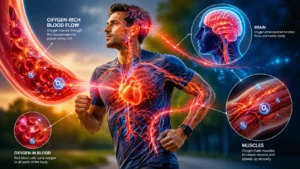
The connection is more literal than most people understand. Energy — at the cellular level — is produced by mitochondria using oxygen and glucose delivered by the bloodstream. When circulation is impaired, oxygen delivery to tissues drops. Mitochondrial output drops with it. The result isn’t dramatic. It feels like low-grade fatigue that coffee only partially addresses, or a mental flatness that sits just below the surface regardless of how much you’ve slept.
The oxygen delivery pathway
Better circulation → more oxygen reaching muscle and brain tissue → more ATP produced per cell → more sustained energy output across the day. This is the chain. Every link matters.
Where blood flow specifically connects to men’s vitality
Erectile function depends entirely on blood flow — nitric oxide-triggered vasodilation allowing adequate blood volume into penile tissue. Men with poor circulation almost always experience some degree of performance reduction before they connect it to a vascular issue rather than hormonal. The same endothelial health that drives everyday energy drives intimate performance — they share the same upstream mechanism.
Nitric oxide is the shared molecule
L-arginine and L-citrulline — amino acids found in watermelon, nuts, and targeted supplements — are direct precursors to nitric oxide production. Research in the American Journal of Clinical Nutrition found L-citrulline supplementation measurably improved exercise performance and vascular function in a dose-dependent manner over 4 weeks. (Source: American Journal of Clinical Nutrition)
The natural ways to improve blood circulation that support energy aren’t separate from those that support intimate performance, recovery, and brain function. They’re the same interventions — because the mechanism is the same. Better vascular function benefits everything downstream simultaneously.
Read More: How Nitric Oxide Works for Men’s Performance — A Plain English Explanation
Conclusion
Circulation isn’t a background process you improve once and forget. It’s responsive — constantly adapting to how much you move, what you eat, how hydrated you are, and how much chronic stress you’re carrying daily.
The natural ways to improve blood circulation on this list aren’t exotic. Movement, hydration, nitric oxide foods, cortisol management, and the right herbs working together create a vascular environment where energy, recovery, and vitality all improve — because they all share the same upstream driver.
Start with movement and water. Add the dietary inputs. Build from there. The improvement is quiet at first — then undeniable. Wayveda was built on that same logic: slow, honest, compounding results over the shortcuts that don’t hold.
If you want targeted support for men’s blood flow, energy, and vitality beyond lifestyle changes, Wayveda’s Power Shots — formulated personally by Dr. Neha Mehta, India’s Top Intimacy Expert — are built for exactly this. Lab-tested. No harmful chemicals. Explore on Wayveda →
Frequently Asked Questions About Natural Circulation Improvement
Q1: What is the strongest natural vasodilator?
Beetroot — specifically its high nitrate content, which the body converts to nitric oxide — has the strongest acute evidence. A single dose of concentrated beetroot juice measurably reduces blood pressure and improves flow within 2–3 hours in clinical studies. L-citrulline from watermelon and garlic’s allicin are close behind. For sustained vasodilation over weeks, ashwagandha’s cortisol-reduction mechanism removes chronic vasoconstriction that none of the food-based options directly address.
Q2: What to drink for poor circulation?
Most evidence-backed options:
- Beetroot juice — highest nitrate content of any common food, converts to nitric oxide directly
- Pomegranate juice — antioxidants protect endothelial lining and support vessel flexibility
- Ginger tea — reduces blood viscosity and has antiplatelet activity
- Plain water — the most underestimated circulation support; dehydration increases blood viscosity and reduces flow measurably
Avoid alcohol — it causes short-term vasodilation followed by sustained vasoconstriction and inflammation that worsens circulation over time.
Q3: Does poor circulation cause hair loss?
Yes — indirectly but meaningfully. Hair follicles are among the most metabolically active structures in the body and require consistent blood supply delivering oxygen and nutrients to the papilla at the follicle base. Chronically poor scalp circulation reduces this supply, shortens the anagen growth phase, and increases shedding over time. Scalp massage and rosemary oil both specifically target this mechanism — improving scalp microcirculation to support follicle activity from outside in.
Q4: How does chronic stress damage blood circulation?
Sustained cortisol triggers vasoconstriction — narrowing of blood vessels — as part of the fight-or-flight response designed for short-term threats. When stress is chronic, this vasoconstriction becomes the baseline. Over months and years, sustained cortisol also promotes endothelial inflammation, reduces nitric oxide production, and increases platelet aggregation — all of which degrade vascular function systematically. This is why the natural ways to improve blood circulation consistently overlap with stress management interventions. They’re addressing the same upstream driver.
Q5: Can poor circulation cause erectile dysfunction?
Directly — yes. Erections require rapid, nitric oxide-triggered vasodilation and adequate blood volume delivered to penile tissue. Any impairment in vascular function affects this mechanism before it affects other organs because the vessels involved are smaller and more sensitive to endothelial health changes. Men experiencing unexplained erectile difficulty without obvious psychological drivers should have a cardiovascular evaluation — it’s frequently the earliest symptom of broader vascular disease, presenting years before cardiac symptoms appear.
Q6: How long does it take to improve circulation naturally?
Realistic timeline with consistent effort:
- Immediate: movement improves flow within minutes; hydration within hours
- 1–2 weeks: dietary nitric oxide support shows measurable blood pressure effects
- 4–6 weeks: consistent exercise produces vascular adaptations — improved endothelial function, better resting tone
- 8–12 weeks: full cardiovascular and hormonal benefits of combined lifestyle changes become measurable in blood work
Circulation responds faster than most people expect — but only when the inputs are consistent, not occasional.