Ayurvedic herbs for men have been discussed for centuries — but the conversation has changed. It’s no longer just tradition holding them up. There’s peer-reviewed clinical research now. Controlled trials. Measurable outcomes in testosterone, cortisol, sperm quality, and physical strength. The herbs that deserved the attention always had it. Now the science agrees.
The best ayurvedic herbs for men’s health work through specific, documented mechanisms — reducing cortisol, protecting testicular cells from oxidative damage, improving mitochondrial energy output, supporting nitric oxide production. Understanding which herb does which helps you use them correctly rather than stacking everything at once hoping something lands.
This covers the full list, which ones have the strongest evidence, and how they work together — without the heritage branding or overclaiming that most Ayurvedic content drowns in.
The Best Ayurvedic Herbs for Men’s Health — The Complete Evidence-Backed List
Not every herb marketed for men’s health has research behind it. This list separates what’s well-supported from what’s mostly tradition.
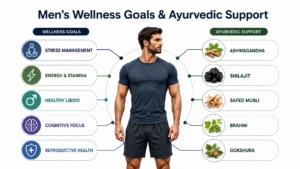
Ashwagandha (Withania somnifera)
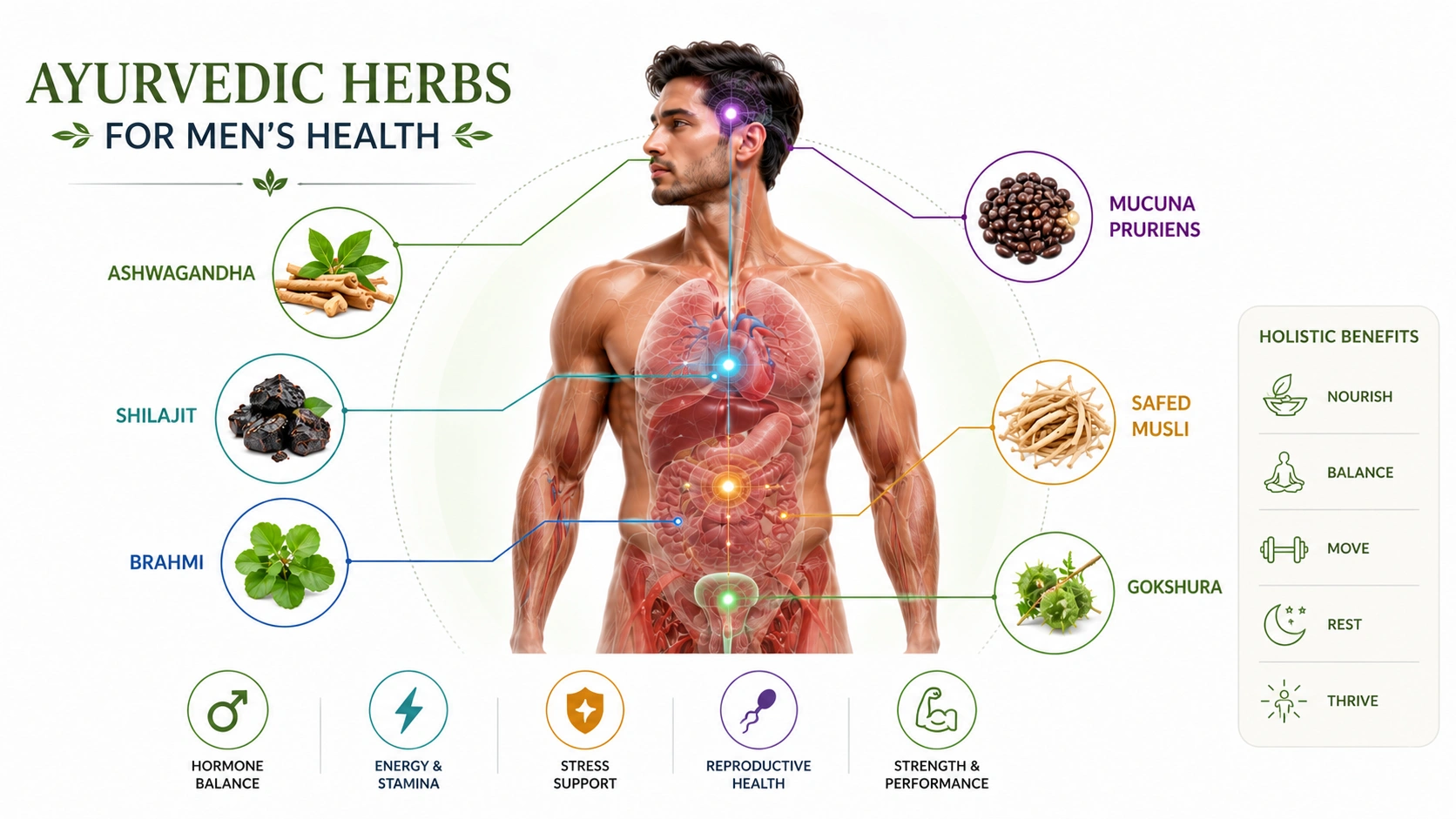
The most studied adaptogen available for men. Clinical trials consistently show it reduces cortisol by 14–32%, raises testosterone by 10–22%, improves sperm count and motility, and increases muscle strength with resistance training. The mechanism is clean — it works primarily through the HPA axis, reducing the cortisol that’s been suppressing testosterone and energy output. 300–600mg of root extract daily, standardised to 5% withanolides, for 8–12 weeks minimum.
Shilajit
A resinous mineral compound from Himalayan rock strata. Its active compound — fulvic acid — improves mitochondrial function, enhances mineral absorption, and directly supports Leydig cell activity for testosterone production. Research in Andrologia documented 20% testosterone increase and significant sperm quality improvements after 90 days. One of the few natural interventions with this level of reproductive evidence.
Kapikacchu (Mucuna pruriens)
Contains L-DOPA, a dopamine precursor. Dopamine drives sexual desire and motivation — not just mood. Mucuna also reduces prolactin, a hormone that suppresses libido when elevated. Clinical studies show improvements in both sperm quality and subjective sexual function. Particularly relevant for men where desire, rather than performance, is the concern.
Safed Musli (Chlorophytum borivilianum)
Traditional tonic for male reproductive health with some clinical backing for testosterone and sperm quality. Less studied than ashwagandha but consistently included in male fertility protocols for good reason.
Gokshura (Tribulus terrestris)
Mixed research — works better in men with genuinely low testosterone than in those within normal range. Has reasonable evidence for supporting libido and mild testosterone improvement. Often overhyped in supplement marketing, but not useless when applied correctly.
Shatavari
Primarily known as a women’s herb — but it has documented antioxidant and adaptogenic properties relevant for men under chronic stress. Reduces oxidative stress at the cellular level and supports hormonal balance in men dealing with fatigue-driven performance decline.
Brahmi (Bacopa monnieri)
The cognitive performance herb. Reduces anxiety, improves memory consolidation, and has documented cortisol-lowering effects after 12 weeks of consistent use. For men where stress and mental fatigue are affecting physical performance downstream — brahmi addresses the upstream source.
Which Herbs Are Actually Best for Men — Ranked by Evidence
The full list matters — but if you’re starting somewhere, evidence strength should guide the decision.
Tier 1 — Strongest clinical evidence
Ashwagandha and shilajit sit here alone. The research across multiple independent controlled trials is consistent, the mechanisms are documented, and the outcomes — testosterone, strength, sperm quality, energy — are measurable in blood work.
Tier 2 — Solid but less studied
Mucuna pruriens and safed musli. Meaningful evidence exists. Studies are smaller or fewer. Clinical outcomes are real but less consistently replicated than Tier 1.
Tier 3 — Useful, context-dependent
Gokshura, shatavari for men, brahmi. These work — but in specific contexts, for specific symptom profiles. Gokshura for low-range testosterone and libido. Brahmi for stress-driven cognitive performance decline.
The best ayurvedic herbs for men’s health aren’t interchangeable. The right choice depends on where the problem actually lives:
- Chronically stressed, low energy, declining performance → ashwagandha first
- Low testosterone confirmed by blood work, poor sperm quality → shilajit and mucuna together
- Reduced desire and motivation specifically → mucuna pruriens
- Overall male reproductive support → ashwagandha and shilajit as a base, others layered in
Stacking all six simultaneously isn’t the approach. Identifying the actual driver and matching the herb to it is what creates real results rather than expensive noise.
What Ayurvedic Approach Is Actually Good for Men — Beyond Herbs Alone

The question that comes up constantly — “what Ayurvedic thing is good for men?” — points to a broader framework that most herb-focused content misses entirely.
Ayurveda’s approach to men’s health isn’t herb-first. It’s system-first. The herbs are the top layer of an approach that starts with identifying what’s depleting the system before adding what’s supposed to build it back up.
What Ayurveda identifies as the primary depleters of male vitality:
- Overwork and chronic mental stress — directly depletes ojas, the Ayurvedic concept of vital energy that maps closely to testosterone and immune resilience
- Irregular sleep — disrupts the body’s natural hormonal repair cycle that happens between 10pm and 2am
- Poor digestion and nutritional absorption — herbs don’t work in a body that can’t absorb them; gut health is foundational, not optional
- Sexual exhaustion without recovery — Ayurveda treats shukra dhatu (reproductive tissue) as the most refined body tissue, depleted by excess and rebuilt by rest and nutrition
The practical Ayurvedic framework for men in 2024:
Ashwagandha for stress and testosterone. Shilajit for energy and reproductive support. Triphala for gut health and nutrient absorption that makes everything else work. Proper sleep, adequate dietary fat and protein, and management of chronic stress as the non-negotiable foundation underneath all of it.
The best ayurvedic herbs for men’s health are most effective inside this system — not as standalone supplements dropped into a high-stress, low-sleep, poor-nutrition lifestyle. That’s the Ayurvedic position, and the clinical research on herb-lifestyle combination protocols consistently supports it over herbs-only approaches.
Conclusion
Ayurveda for men’s health works — when it’s applied honestly. Not as tradition, not as heritage marketing, but as a set of documented biological interventions targeting the upstream drivers of testosterone, energy, and reproductive health.
The best ayurvedic herbs for men’s health — ashwagandha, shilajit, mucuna, gokshura — each address specific mechanisms. They’re not interchangeable. They’re not all needed simultaneously. They’re most effective inside a foundation of adequate sleep, nutrition, and managed stress that gives them the conditions to actually work.
Start with the right herb for the right problem. Give it 90 days. Measure the difference where it counts — in blood work, energy levels, and performance — not in how the supplement marketing made you feel when you ordered it.
If you want clinically formulated support combining the core herbs for men’s vitality, Wayveda’s 3X Black Combo — built personally by Dr. Neha Mehta, India’s Top Intimacy Expert — covers the full stack in one. Lab-tested. No harmful chemicals. Explore on Wayveda →
Frequently Asked Questions About Ayurvedic Herbs for Men
Q1: What is natural Viagra in Ayurveda?
Shilajit is most commonly called Ayurveda’s natural Viagra — but the comparison is mechanical, not functional. Viagra works acutely on blood flow within an hour. Shilajit builds hormonal and cellular foundations over weeks. Ashwagandha and safed musli are also referenced this way, but shilajit has the most consistent evidence for testosterone and reproductive function specifically. For men with clinically significant erectile dysfunction, a proper medical evaluation is always the right first step — herbal support works best alongside, not instead of, that process.
Q2: Which is the king of herbs in Ayurveda?
Ashwagandha holds that title consistently — known as Rasayana in classical Ayurveda, meaning a rejuvenating adaptogen with broad-spectrum benefits. For men specifically, it leads the best ayurvedic herbs for men’s health list on evidence volume, consistency across studies, and the breadth of outcomes documented — testosterone, cortisol, sperm quality, muscle strength, anxiety reduction. No other single herb matches its clinical depth for male health specifically.
Q3: How long do Ayurvedic herbs take to work for men?
Honest timeline by herb:
- Ashwagandha cortisol reduction: 2–4 weeks
- Ashwagandha testosterone improvement: 6–8 weeks
- Shilajit energy and mitochondrial effect: 2–3 weeks
- Shilajit testosterone and sperm quality: 8–12 weeks
- Mucuna pruriens desire and dopamine: 4–6 weeks
One full hormonal cycle takes approximately 90 days. Men who evaluate results at two weeks are measuring before the mechanism has had time to run. Ninety days of consistent daily use is the minimum meaningful evaluation window.
Q4: Can Ayurvedic herbs be taken with modern supplements?
Most combinations are safe — but specific interactions exist. Ashwagandha with thyroid medication needs monitoring because it actively supports thyroid function. Shilajit with blood pressure medication requires caution through its mineral absorption pathway. Brahmi with sedatives or anxiety medication can compound effects. For men on no medication, combining ashwagandha and shilajit is well-supported and commonly recommended. Always disclose supplement use to your doctor if you’re on prescription medication — not because herbs are dangerous, but because the interactions are real and manageable when known.
Q5: Is it safe to take Ayurvedic herbs for men every day?
For the main evidence-backed herbs — yes, at therapeutic doses for healthy men. Ashwagandha at 300–600mg daily is well-tolerated across studies running up to 12 weeks, with no significant adverse events in healthy populations. Shilajit at 300–500mg purified extract is similarly safe. The caveat is always purification and sourcing — raw shilajit can carry heavy metal contamination; purified standardised extract is the only form worth using. Daily consistency over 90 days is specifically what creates the hormonal and cellular changes the research documents.
Q6: Do Ayurvedic herbs for men work better together or alone?
Stacked strategically — better. Ashwagandha and shilajit work through complementary mechanisms: ashwagandha targets cortisol reduction and HPA axis regulation; shilajit targets cellular energy and Leydig cell function directly. Together they cover more of the testosterone production pathway than either does alone. Adding mucuna pruriens for dopamine and desire creates a third distinct mechanism without overlap. The principle is complementary pathways — not random stacking. The best ayurvedic herbs for men’s health work harder when their mechanisms don’t compete but build on each other.