Most men who experience this assume the worst immediately — that something is physically broken, permanently, in a way that can’t be undone. That fear makes the next attempt harder. Which makes the fear worse. The cycle locks in before they even understand what started it.
Stress and erectile dysfunction are more directly connected than most men realise — and more commonly connected than most are willing to say out loud. The nervous system pathways that drive arousal and erection are the same ones disrupted by chronic stress, anxiety, and elevated cortisol. It’s not a weakness. It’s not a failure. It’s biology. And understanding that distinction is where the problem actually starts getting addressed.
This covers how stress causes ED, what anxiety-related ED specifically looks like, what the signs are, and what the evidence says actually helps — without shame, and without shortcuts.
The Science Behind Stress and Erectile Dysfunction
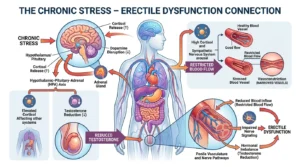
Erections are a parasympathetic nervous system event. The “rest and digest” branch — not the “fight or flight” branch. When you’re relaxed, blood flows correctly, nitric oxide releases, and the response follows naturally. When you’re stressed, the opposite system activates — and it overrides the one that supports arousal.
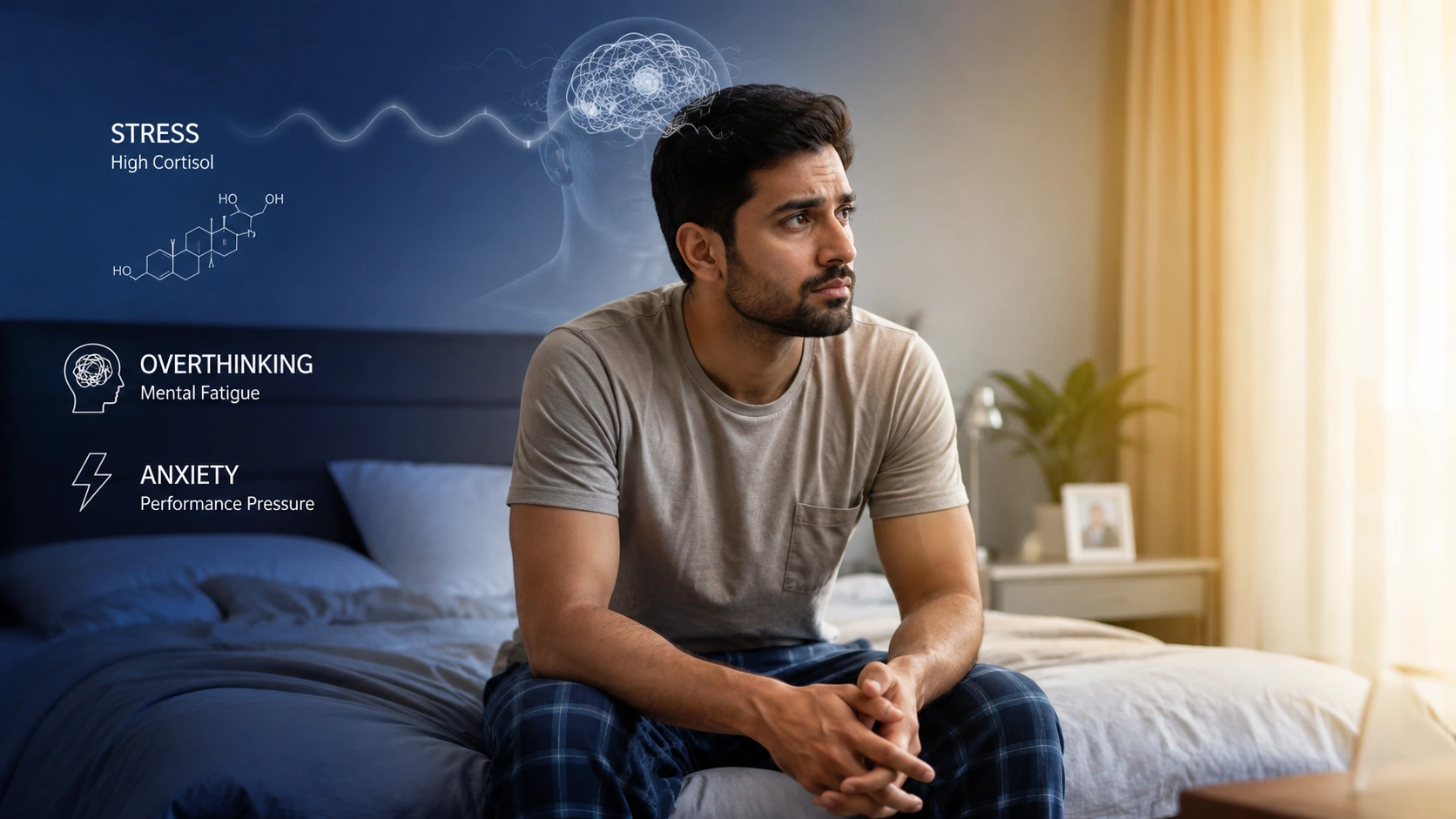
Cortisol — the primary stress hormone — interferes with erectile function through several simultaneous pathways:
- Constricts blood vessels — erections require increased blood flow to penile tissue; cortisol-triggered vasoconstriction works directly against this
- Suppresses testosterone — testosterone drives sexual desire and arousal; chronically elevated cortisol lowers free testosterone measurably over time
- Activates the HPA axis — the hypothalamic-pituitary-adrenal stress response deprioritises reproductive function entirely when the body perceives sustained threat
- Disrupts dopamine signalling — dopamine is the desire and motivation neurotransmitter; chronic stress depletes it, which is why prolonged stress kills desire before it even reaches the physical response
The result is stress and erectile dysfunction operating on two levels simultaneously — physical (blood flow, testosterone, vascular tone) and psychological (desire, anticipation, performance fear). Once both layers activate — and they usually do, quickly — the cycle becomes self-reinforcing.
An episode happens. The man anticipates it happening again. The anticipation creates stress. The stress activates the same physiological pathway that caused the first episode. It happens again. Now it’s a pattern.
This is the distinction between stress-induced ED and organic ED. Organic ED has a physical root — vascular disease, diabetes, hormonal disorder, medication side effect. Stress-induced ED is neurologically driven. The physical mechanism is intact; it’s the nervous system signalling that’s being disrupted. The treatment pathway is different, and misidentifying one as the other means treating the wrong thing entirely.
How to Manage Erectile Dysfunction Caused by Stress
Managing stress and erectile dysfunction starts with correctly identifying the type — then targeting the actual mechanism rather than the symptom.
For stress and anxiety-driven ED, the approaches with the strongest evidence are:
Cognitive Behavioural Therapy (CBT)
 The single most evidence-backed intervention for psychological ED. A meta-analysis in the Journal of Sexual Medicine found CBT significantly improved erectile function in men with psychological ED — with effects maintained at 6-month follow-up. The mechanism is direct: CBT systematically breaks the anticipatory anxiety cycle that maintains the pattern. It treats the loop, not just one episode.
Sleep — the most underused lever
Most testosterone is produced during deep sleep between 3–7am. Men sleeping under 6 hours show measurably lower testosterone and greater cortisol reactivity the following day. Fixing sleep doesn’t resolve everything — but it removes one of the most significant biological drivers of stress-related performance issues consistently.
Ashwagandha for cortisol reduction
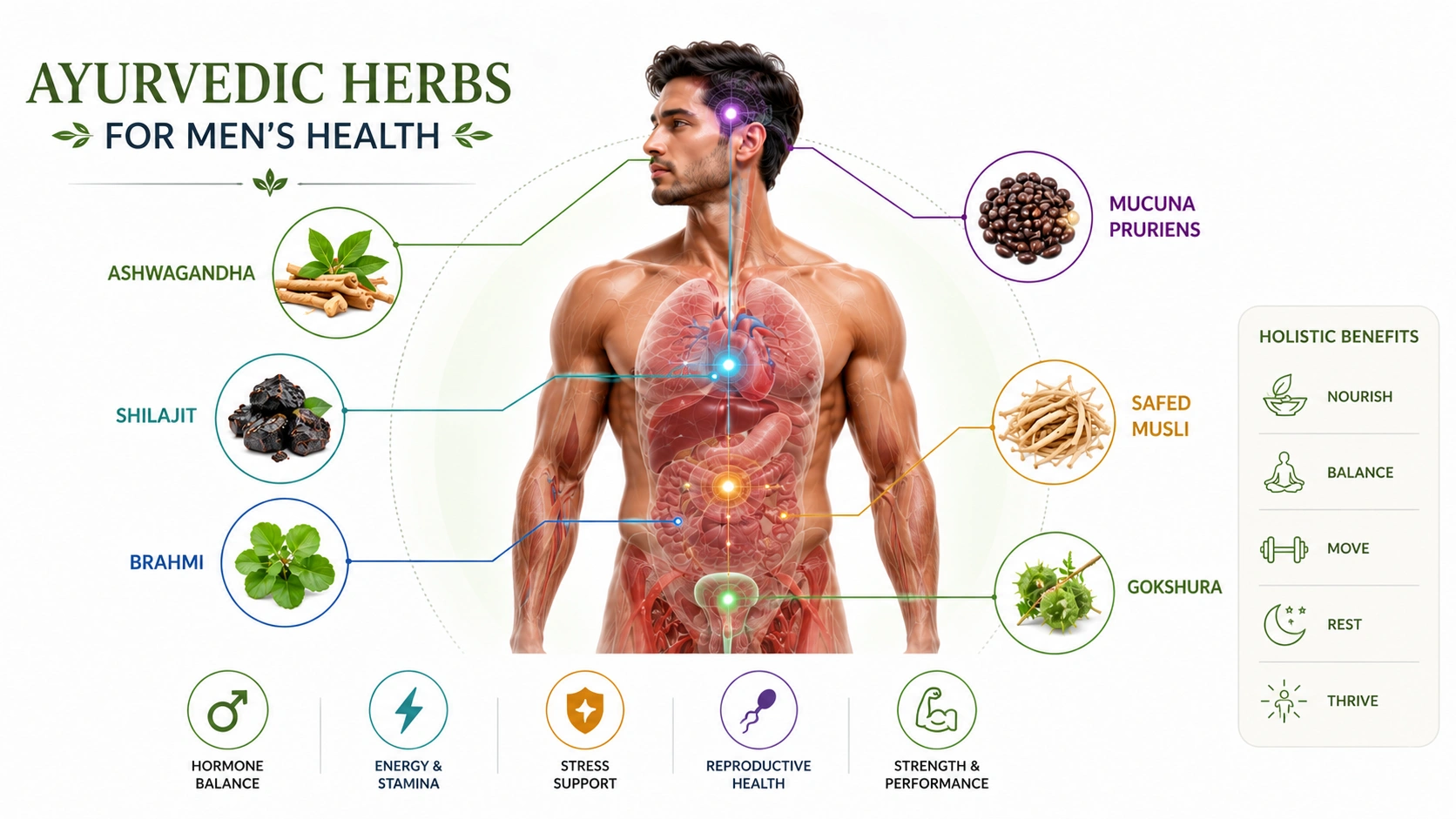
300–600mg daily of ashwagandha root extract has documented cortisol reduction across multiple clinical trials. Reduced cortisol means reduced physiological suppression of the arousal pathway — and several studies show improvement in self-reported sexual function alongside the hormonal changes. Not a quick fix. A consistent one.
Aerobic exercise
Research in Sexual Medicine Reviews found regular aerobic exercise — 30 minutes, four times weekly — improved erectile function scores significantly in men with mild-to-moderate ED, with effects comparable to PDE5 inhibitors in the mild range. The mechanism: improved cardiovascular health, better nitric oxide production, lower cortisol, and rising testosterone over time.
The core of managing this isn’t forcing an outcome. It’s removing what’s suppressing the system and allowing the body’s own response to function again.
How to Fix Anxiety-Related ED — The Practical Approach
Anxiety-related ED has specific patterns that distinguish it from physically-driven ED — and those patterns point directly to what actually resolves it.
Recognising the signs it’s anxiety-driven:
- Normal erections during masturbation or on waking — but not consistently with a partner
- Erection present before sex but lost during it
- The problem began during or immediately after a high-stress life period
- First episode produced intense fear, which preceded the second episode directly
- Inconsistent — works sometimes, not others — without physical explanation
If these match, the cause is neurological and psychological, not vascular. The approach changes completely.
Sensate focus
A structured technique from sex therapy that removes performance pressure by temporarily removing the goal entirely — physical connection without expectation of erection or sex. Breaks the anticipatory anxiety loop at its foundation. Used by sex therapists globally with strong clinical outcome evidence.
Open communication with a partner
Anxiety-related ED grows in silence. Research consistently shows men who name it openly with their partner — not dramatically, just honestly — report significantly reduced performance anxiety and faster functional recovery. The silence is often more damaging than the episodes.
Address the underlying condition
Anxiety disorders, depression, and chronic work stress all sustain stress and erectile dysfunction through cortisol and dopamine disruption. Treating the root condition directly improves sexual function. This isn’t a soft suggestion — it’s the most evidence-consistent finding across psychological ED research consistently.
According to the British Journal of General Practice, psychological factors are implicated in approximately 40% of ED cases in men under 40 — a figure that rises substantially when accounting for mixed presentations. (Source: BJGP)
Conclusion
Stress and erectile dysfunction sit in a loop that feels permanent before it’s understood. It isn’t permanent. It’s a nervous system response to conditions that can be changed — cortisol, sleep, anxiety, and the anticipatory fear that makes every subsequent encounter harder than it needs to be.
The resolution is rarely one thing. It’s consistent sleep, cortisol management, psychological support where needed, and patience with the timeline. For most men, understanding the mechanism clearly — really understanding it — is the first real shift. Because it turns an apparently mysterious problem into a manageable physiological pattern with known, workable solutions.
Wayveda was built for exactly this kind of conversation. Intimate wellness without judgment, and without the silence that makes everything harder.
If you want targeted support for men’s confidence and performance alongside lifestyle changes, Wayveda’s Power Roll-On — formulated personally by Dr. Neha Mehta, India’s Top Intimacy Expert — is designed to support men in the moment. No harmful chemicals. Explore on Wayveda →
Frequently Asked Questions About Stress and Erectile Dysfunction
Q1: How common is stress-induced ED?
More common than most men know — partly because it’s rarely disclosed. Research suggests psychological factors are the primary driver in approximately 40% of ED cases in men under 40, with stress and performance anxiety being the most frequently cited causes within that group. The real figure is likely higher — most men never mention it to a doctor, which means the data consistently underrepresents actual prevalence across all age groups.
Q2: How can erectile dysfunction caused by stress be addressed naturally?
The most consistently supported approaches:
- Target the stress source directly — work pressure, relationship tension, anxiety disorder
- Sleep 7–9 hours consistently — testosterone production depends on this window
- Ashwagandha 300–600mg daily for cortisol reduction
- Aerobic exercise 4 times weekly — 30 minutes is sufficient
- CBT or sex therapy specifically for the anticipatory anxiety cycle
None of these work overnight. The pattern took time to form — resolution requires consistent, sustained effort across several weeks.
Q3: Can stress-related ED be temporary and fully reversible?
Yes — and it often is, when addressed early. Because the origin is neurological and psychological rather than vascular, it responds directly to the conditions that created it. When stress reduces, sleep stabilises, and the anxiety cycle is interrupted — erectile function typically returns without medical intervention. Men who address it early rather than letting the pattern entrench recover faster. The longer it stays unnamed and unaddressed, the more deeply the anticipatory anxiety reinforces itself.
Q4: Does stress-related ED need medication?
Not always. For mild-to-moderate psychological ED, CBT and lifestyle changes address the root more completely than medication alone. PDE5 inhibitors can be useful short-term to break the anxiety cycle — one successful experience reduces anticipatory fear significantly, making the next attempt less pressured. But medication without addressing the underlying stress and anxiety rarely produces lasting improvement. The most durable outcomes consistently come from treating the cause rather than only managing the symptom.
Q5: What’s the connection between low testosterone and ED?
Testosterone drives sexual desire — the motivation to initiate in the first place. When testosterone drops, libido falls, and without adequate desire the arousal pathway doesn’t activate reliably. Stress and erectile dysfunction interact with testosterone directly: cortisol suppresses testosterone production over time, which reduces desire, which makes ED more likely — creating a three-way reinforcing loop. This is why complete management includes addressing testosterone through sleep, nutrition, and cortisol reduction, not only the erection itself.
Q6: When should ED be evaluated by a doctor?
If it’s been persistent beyond 4–6 weeks, occurs across all situations including masturbation, or comes alongside other symptoms — significant drop in morning erections, reduced libido, fatigue, or depressive symptoms — a clinical evaluation is necessary. A doctor can distinguish physical from psychological causes through blood work: testosterone, prolactin, blood glucose, and a lipid panel. Early evaluation is always better than waiting — and most men who go find the conversation considerably easier than they expected.